


search
date/time

Tue, 10:00PM
moderate rain
13.2°C
NE 7mph
moderate rain
13.2°C
NE 7mph
 | Sunrise | 6:14AM |
| Sunset | 5:30PM |  |
P.ublished 19th March 2025
arts
Austen And Turner: A Country House Encounter
![Left: Austen portrait (Alamy) incamerastock / Alamy Stock Photo. Right: Self-Portrait, c.1799, Joseph Mallord William Turner. Tate, Accepted by the nation as part of the Turner Bequest 1856. Photo: Tate [shown cropped]](https://s3.eu-west-2.amazonaws.com/p.ublished/media2/2025/mar/85680/austen_turner.png)
Left: Austen portrait (Alamy) incamerastock / Alamy Stock Photo. Right: Self-Portrait, c.1799, Joseph Mallord William Turner. Tate, Accepted by the nation as part of the Turner Bequest 1856. Photo: Tate [shown cropped]
Harewood House Trust is marking 250 years of novelist Jane Austen (1775-1817) and painter Joseph Mallord William Turner (1775-1851) with the exhibition ‘Austen and Turner: A Country House Encounter’. Two contemporary award-winning creatives have been commissioned to reflect on Austen and Turner’s legacies in response to artworks, manuscripts and historical objects that bring Austen and Turner together for the first time.
Visual artist Lela Harris will produce a new work inspired by the literary world of Jane Austen, and poet and performer Rommi Smith becomes Harewood’s Writer in Residence, reflecting and responding to the themes of the exhibition through poetic form. Austen and Turner is a significant collaborative exhibition and research project between Harewood House Trust and the Centre for Eighteenth Century Studies at the University of York, with advice from independent curatorial consultant, Jade Foster.
Contemporary Commissions
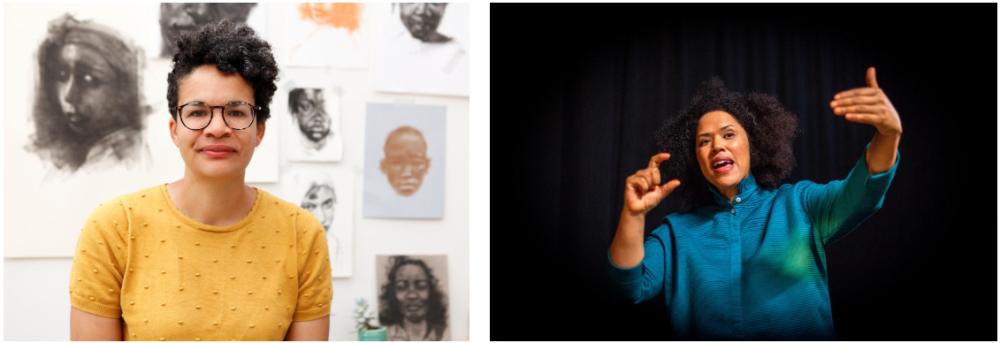
Left: Lela Harris, photo credit Lorna Chorley. Right: Rommi Smith Photo credit: Lizzie Coombes
Lela Harris said: "I love country houses and sometimes like to imagine that I’m a time-travelling artist, exploring, researching and being immersed in their collections and archives. I’m enjoying peeping behind the curtains of Harewood, exploring the often overlooked histories of the people who shaped the house and its objects. It’s a unique opportunity to examine the house’s historical links to colonialism and how these connections shape our experience of Harewood today."
Rommi Smith is a multi-award-winning poet, playwright, theatre-maker, librettist, broadcaster and academic. Smith will be spending time at Harewood House as Writer in Residence researching and responding to the works of Austen and Turner. Smith will be experimenting with poetic form and composition tailored to the aesthetics and thematics of the exhibition. She will co-curate and a creative, generative and collaborative workshop space where audiences can engage and respond to the exhibition through writing and performance. For the exhibition, Smith is working with Thin Ice Press at the University of York, to create prints of her work, written during the residency and host a cumulative performance of original work produced in collaboration with composer Christella Litras.
Rommi Smith said: “Leeds is my home. I have lived and worked in Leeds for over thirty years. I am thrilled to be Writer in Residence for Harewood House, specifically for the Austen and Turner exhibition. The exhibition begins with a provocation: ‘what if…’ and invites us to consider the ‘conversation’ between Jane Austen and JMW Turner, as creatives living within each other’s temporality. As much as the exhibition is one of exhibits, it is one of voices. As a poet and theatre-maker, I am fascinated by voices and what they have to say. And as an archival researcher, I am interested by ghosts - the voices of the past and how they speak to us in the present tense.
Objects on loan
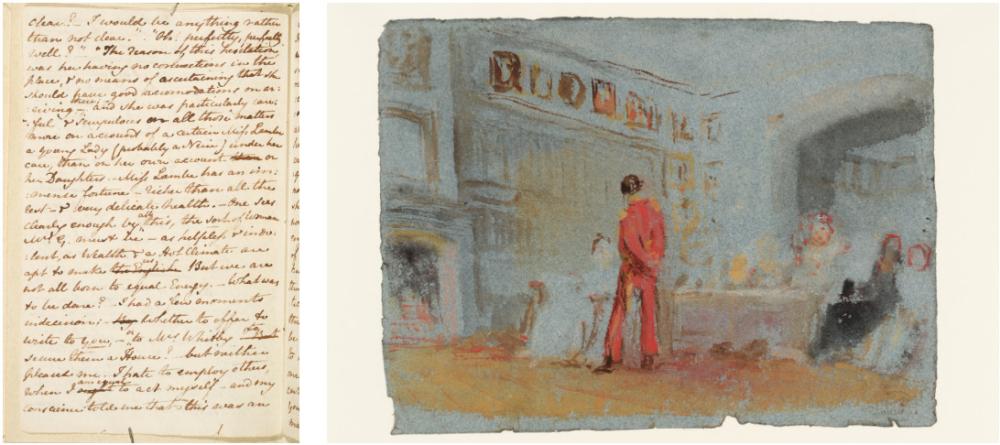
Left: Jane Austen, Sanditon autograph manuscript, 1817. Reproduced by permission of King’s College, Cambridge. Photo credit: DIAMM. Right: The Red Uniform, 1827, Joseph Mallord William Turner. Tate, Accepted by the nation as part of the Turner Bequest 1856. Photo: Tate
Austen’s life and literary works are represented by rarely shown handwritten manuscripts and published works. On loan from the British Library and Jane Austen’s House Museum are letters written by Austen to her sister, Cassandra. Further works belonging to family members include an Austen family music manuscript, and a naval sketchbook and journal belonging to two of her elder brothers, Admiral Sir Francis Austen and Rear Admiral Charles Austen.
Austen’s creative process is revealed by the handwritten manuscript of her final novel, Sanditon. Remaining unfinished at her death in 1817, Sanditon is on loan from King’s College Cambridge, and will be shown alongside first editions of earlier works from different collections, including Pride & Prejudice, Sense and Sensibility and Mansfield Park. The loans to Austen and Turner are supported by Arts Council England and the Weston Loan Programme with Art Fund. Created by the Garfield Weston Foundation and Art Fund, the Weston Loan Programme is the first ever UK-wide funding scheme to enable regional museums to borrow works of art and artefacts from national collections.
The shortened address for this article is: newspub.uk/01u40