


search
date/time

Sun, 4:00AM
scattered clouds
13.5°C
WSW 10mph
scattered clouds
13.5°C
WSW 10mph
 | Sunrise | 5:46AM |
| Sunset | 6:09PM |  |

Andrew Liddle
Guest Writer
P.ublished 10th August 2026
arts
Ed O’Donnell, The Doyen Of Leeds Jazz
Andrew Liddle remembers one of the greats of British Trad Jazz
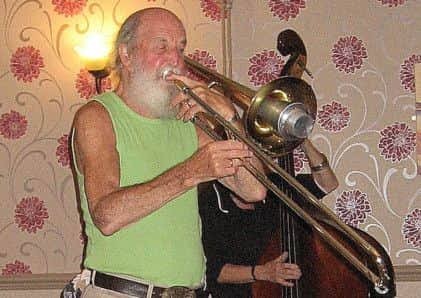
Ed O’Donnell
The first time I saw Ed O’Donnell was in the late 1960s and he’d already been playing with great distinction for more than twenty years. I’m pleased to have been able to enjoy so much of the rest of his career, countless gigs in so many venues in and around his native city of Leeds and farther afield, and to have been able to call him a friend. He always seemed to have a nickname for people he liked and mine was the Prof! Make of that what you like!
In the last ten years the Yorkshire Post newspaper took to referring to Ed, in its entertainments’ section, as the ‘indestructible’. No man is and, sadly, Ed went on ahead, as they say in Jazz circles, on 14th February, 2014, a matter of hours after the occasion of his 87th birthday. It was only a week or so after he had raised the roof with his band at Thornton Watlass, in the Yorkshire Dales - and only a matter of days before he was due to play again in Bingley, near Bradford.
Had he done this gig, it is not difficult to imagine how it would have gone because in so many ways all Ed’s gigs were the same - and this is meant as the highest compliment and not a criticism. It is a matter of fact that the Ed O’Donnell Band always sounded the same, regardless of personnel. Over the decades there were numerous changes as players came and went, but the one constant - apart from the trombone maestro himself - was the New Orleans’ style and repertoire. Some people call it ‘style creep’, the subtle way a band’s style shifts over time. I asked him once how he avoided it. ‘I think I dominate them,’ he said with a twinkle, ‘make them see we play New Orleans or not at all!’
Certainly this tall, slim, heavily-bearded man, who put the remarkable longevity of his strength down to his wartime experiences as a Bevin Boy coal miner, always did it his way, which was like no others. No one else ever stripped down so readily to a colourful vest, usually after the first solo and regardless of temperature. No one else ever terminated his own vocal with that revolving hand wave, a sort of self-mocking acknowledgement of the crowd’s applause. In many ways, he was pure Vaudeville, rolling his eyes in search of a lyric’s innuendo; embracing his own heart when apparently overcome with emotion; jabbing his index finger into his ear to check his own voice when singing a slow Blues; tailgating with joyous extravagance; lumbering from side to side when delivering Moose March; or staring fixedly into the middle distance to appraise some else’s solo.
And his patter never changed. True, a joke or aside might disappear for a decade or more only to suddenly resurface when least expected and all but forgotten. Before the last number, he would flourish his old pocket-watch and study it intently. At the very end, he would lurch into a lengthy exhortation, inviting his audience to tell their friends, neighbours, in-laws, outlaws, rentman, gasman, postman (the list was interminable) to tell their friends (etc., etc.) that the Ed O’Donnell Band was … He didn’t have to complete the phrase because everybody did it for him, before he added in confirmation ‘The only game in town!’ I asked him once where this came from. ‘I’ve said it for so long, I can’t remember,’ he said, before adding he thought he might have heard it first in a Western film.
When talking during the break he could be persuaded into unpacking one of his tremendous anecdotes about some of the people he’d played with, often referring to the more famous by surname only, as Cooper, Disley, Colyer. Only his mate, Acker, escaped this. When asked whom he most admired in Jazz, he said without a second’s hesitation, ‘Jim Fuller, a brilliant musician and a very modest man.’ A wonderful tribute to his former trumpeter whose career had been terminated by arthritis.
Great entertainer that he was, Ed could showboat with the best but never at the expense of his music. He had nothing but contempt for those who felt it necessary to dress up in fancy hats and waistcoats, preferring instead to dress down, in fact, and let the music speak for itself. In truth, he didn’t have much time for any other kinds of Jazz. ‘Bunk is our God,’ he observed on stage. Apparently someone once approached him and said, ‘I see you’re still playing that old Bunk Johnson stuff!’ Ed’s withering reply was: ‘What else is there?’ Privately he would talk encomiastically about Jim Robinson, George Lewis, Ma Rainey, Bessie Smith, Leadbelly and, perhaps surprisingly, Jimmie Rodgers, the white ‘Blue Yodeller’, to whom he introduced me, and the Carter family. I cannot honestly remember him mentioning too many others, however.
In 1948, Ed joined The Vernon Street Ramblers, which took its name from the street on which the Leeds College of Art was situated where several of its members were students – and where one day Ed would become a lecturer on diamond mounting and hand-engraving. It was one of those life-changing moments that come completely by chance. ‘One day,’ he explained, ‘I was walking through the city and heard this most fantastic music coming from an upstairs room of the art college.’ He quickly made his way to the source and discovered Alan Cooper, on clarinet, Diz Disley, on banjo, Pat Webb, on cornet, Henry Moore on drums and Ted Fenton, on trombone. Ed took to sitting in with them and eventually ‘eclipsed’ (Ed’s word) Fenton.
Soon Ed became a founder member of Bob Barclay’s ground-breaking Yorkshire Jazz Band, originally called the Twin City Washboard Stompers, the suggested name change coming from Graeme Bell, over from Australia. Pretty soon, they were in London making legendary Tempo recordings, some of the earliest and best of the British Traditional Jazz revival.
Ed always remembered with great affection those nights, at the Adelphi and at the Metropole, in Leeds, with Dick Hawdon on trumpet; ‘Happy’ Harker’, clarinet, later replaced by Cooper; Bob Barker, tuba; Eddie Encale, banjo (later Disley); Art Rigg, piano and ‘Woody’ Wolstenholme, banjo.
It was not long before he was leading his first band, the Paramount Jazz Band, formed with Jim Leonard, on trumpet and ‘Sleepy’ Green, piano, Raymond Hill, drums and John Cooke, on banjo. Before long he added schoolboy clarinettist, Martin Boland, with whom he was soon to start the White Eagles (which existed for sixty-five years), but which in those early days played at The Peel and The Royal.
It was in 1954 that Rex Harris in the Penguin History Of Jazz identified Ed as ‘a trombonist of great promise, one of the best of the new crop’. It is doubtful the eminent Jazz critic would have done so had Ed remained in Leeds, but by then he had been headhunted by Bill Colyer and was based in London, playing with Ken Colyer’s re-formed band, forming a life-long friendship with Acker Bilk, with whom he shared digs. When I asked Ed if he had any regrets about leaving Colyer’s band, he rolled his eyes forlornly but said forthrightly that he had none: ‘You can never regret decisions you made in life because you made them for good reasons at the time’. One such reason was the near impossibility of surviving in London on six pounds a week.
Returning to Leeds, Ed played for a time with Keith Smith’s Huddersfield-based band, before being briefly bitten by the Skiffle bug, playing bass (‘affecting to’, as he put it) with The Steel Drivers. Soon he was putting together another very strong band with Jim Fuller and clarinettist Martin Fox. This was the best of times, as Ed remembered it, playing all around the West Riding, at the height of the Trad Boom, at students’ unions, rag balls, sometimes after hours at ‘lock-ins’ in pubs without a music licence. ‘Sometimes we got a quid apiece, sometimes fifty bob,’ he recalled. ‘We certainly didn’t do it for the money!’
In 1988, he was part of the reunion of the Yorkshire Jazz Band, filmed by Yorkshire Television, with the surviving members: Cooper, Disley, Hawdon, Wolstenholme and, on tuba, Jim Bray in place of Bob Barclay who had gone on ahead. Anybody who saw it could never forget the sight of the impressively bearded figure walking grandly into his home from home, the Adelphi, sporting a deerstalker. Another reunion came in 2004, in memory of Ken Colyer, performed at the Purcell Room, South Bank, London, attended by such luminaries as Ian Wheeler, Stan Greig, Micky Ashman, Ray Bowden and Ed’s old mates, Diz and Acker.
Decades came and went but Ed played on and was active to the very end. It is a matter of record that his last gig was the lunchtime session at Thornton Watlass. And it was some ‘territory band’ with Arthur Stead (‘the Reverend’), on trumpet, Frank Brooker, clarinet, Richard Speight, banjo, Annie Hawkins, bass and Barry Wood, drums.
Whenever I listen to the many recordings of the band I made on my portable Edirol, my own thoughts turn back to the first time I saw him, the first of so many ambrosial nights in The Adelphi. The Tetley’s beer, brewed a stone’s throw away, flowed like water and tasted like wine. I was a young man and Ed was in his prime. The Jazz was simply wonderful to hear, echoing down Briggate. I found myself running up the stairs and experiencing the most joyous flooding of the senses as I was embraced by a hot fug of fags, beer fumes and life-affirming music blissfully loud and stomping. Pure New Orleans!
No flower-power junkhead of the time ever got a buzz like that.
Also by Andrew Liddle...
The Trial Of Romeo Oscar - Stephen Joseph Theatre, ScarboroughObituary: Sir Billy Boston - The Wigan WarriorA Right Royal Handbagging In ScarboroughFrom Alpine Roots To Global Stages: How Oesch’s Die Dritten Keep Tradition AliveWinterreise In The Ryedale Heatwave: Icy Solitude At The Height Of SummerThe shortened address for this article is: newspub.uk/020g6
Search Results