


search
date/time

Tue, 1:00PM
overcast clouds
11.4°C
ESE 13mph
overcast clouds
11.4°C
ESE 13mph
 | Sunrise | 6:41AM |
| Sunset | 4:57PM |  |

Andrew Palmer
Group Editor
P.ublished 30th May 2026
lifestyle
Spinning Plates: Tommy Banks On Hospitality, Influencers And The Village That Built Him
_Credit_ Andrew Hayes-Watkins (1).jpg)
Tommy Banks
Photo: Andrew Hayes-Watkins
"There's certainly nothing I've left out because it feels too raw," he says when I ask which of those timelines proved hardest to put on a stage honestly. "This is a very honest, accurate and vulnerable depiction of what's happened over the last twenty-five years. "If anything, it's more of a shame that I've had to leave things out that were really interesting, funny, or amazing— simply because so much has happened over that time, and it's impossible to fit it all in."
That candour is characteristic. Banks is not a chef who deals in mystique, which is partly why the wider conversation about the state of British hospitality has fallen to him as much as to anyone of his generation. Three pubs are closing every week under the combined weight of business rates and VAT; the high streets are visibly thinning. Spinning Plates Live, he concedes, is both a love letter and a warning.
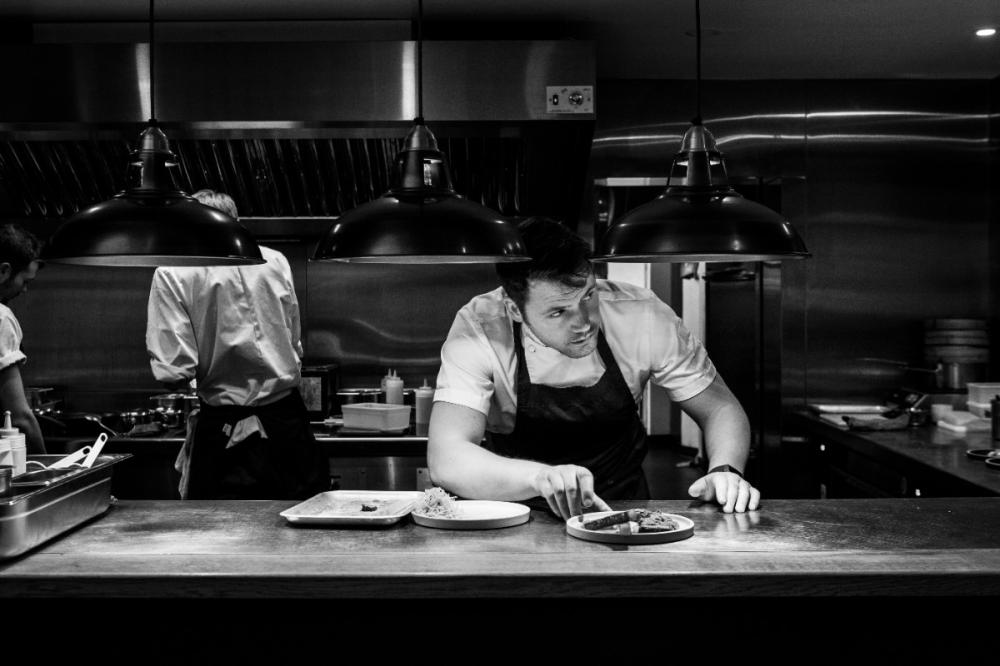
Tommy Banks: Roots Service
What does he want people to do as they leave the theatre? "The amazing thing about hospitality is that you get to celebrate people's special occasions with them. And I really want Spinning Plates Live to feel like a beautiful occasion in itself — a live event that brings people together. I hope people leave enthused by what they've seen, emboldened by the message behind it, and hopefully go straight out afterwards to support local restaurants and cafés."
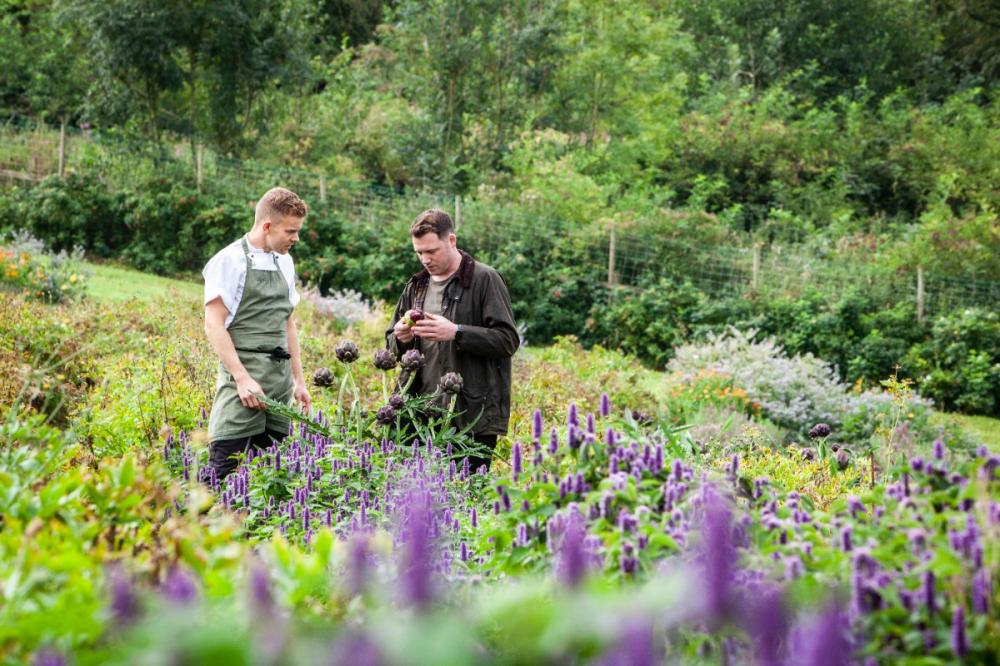
The Black Swan Garden
Photo: Andrew Hayes-Watkins
Oldstead was sleepy to the point of invisibility before The Black Swan put it on the map. "Growing up, nobody had heard of Oldstead. When I said where I was from, people didn't know it. So I'm very, very proud of what we've built there." He is also, refreshingly, sceptical of the idea that any of it could be lifted and reproduced elsewhere.
"Nothing we do at The Black Swan is really replicable anywhere else, and I think the key thing is that we were there to begin with. We had a farm, we had a community, and we built on top of that. Almost every other restaurant or hospitality business starts with a concept and then tries to fit that concept into a location. Ours has been a natural evolution of family life, farming and community."
It is an unfashionable thing to say in an industry that increasingly trades on scalability. Banks arrived in the kitchen at seventeen with no formal training — a few unpaid stages, including a week at Raymond Blanc's Le Manoir aux Quat'Saisons, and a willingness to learn on the job. Whether that absence of classical training was a handicap or a making is a question he has clearly turned over many times.
"I don't think my lack of formal training was a handicap, because I wasn't bound by the constraints of being trained in a classical way. I hugely admire chefs who have classical training, and there are chefs who are far more technically experienced, skilled and gifted than I am. But I think my route into cooking has led me to create some of the most interesting food."
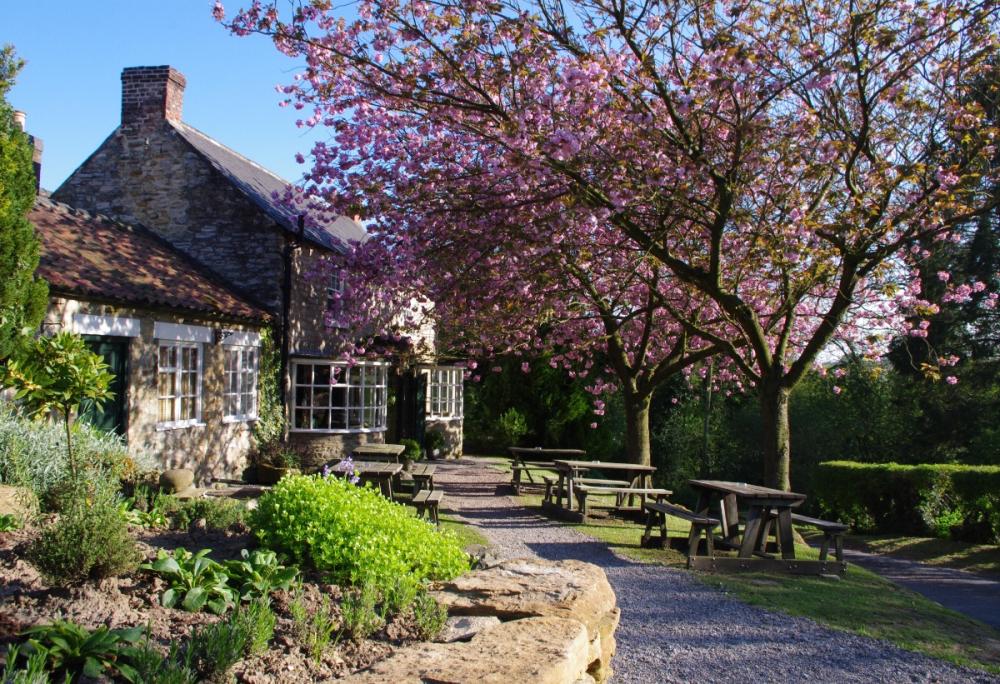
The Black Swan, Oldstead
Photo: Andrew Hayes-Watkins
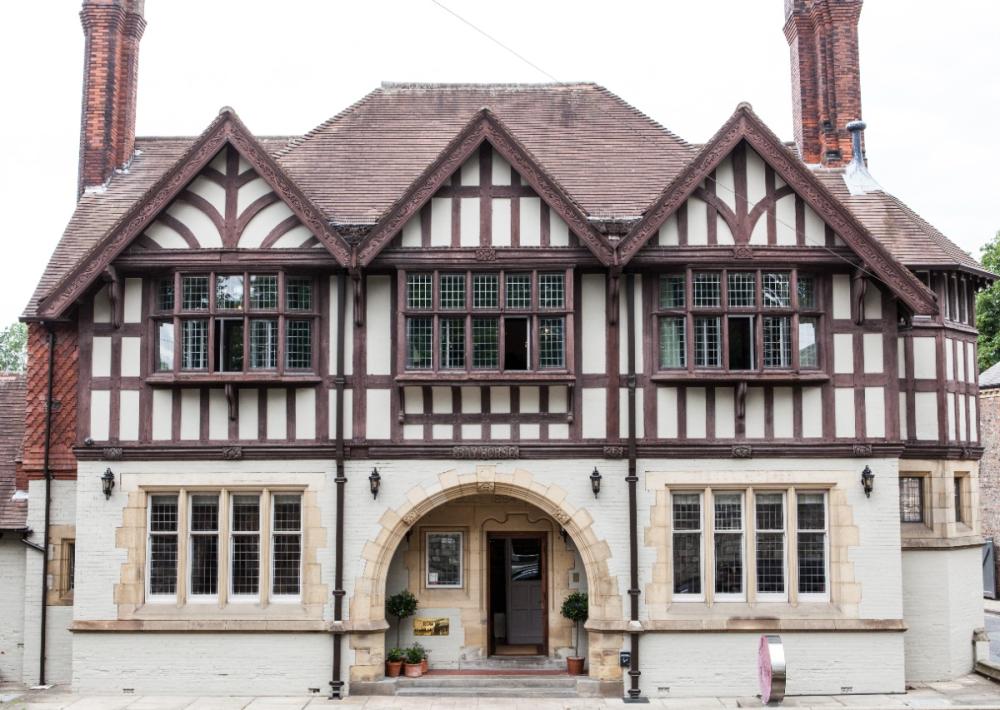
Roots, York
Photo: Andrew Hayes-Watkins
.jpg)
The Abbey Inn, Byland
The camera and the kitchen
Gordon Ramsay has lately declared himself a fan of influencers, a position that has drawn a certain amount of weary scepticism from the older guard of restaurant criticism. I put it to Banks directly: does an Instagram photograph and a ninety-second reel actually add anything to the culture of eating out, or does it flatten what restaurants do?
His answer is more generous than I had expected. "Yeah, I think I am a fan of influencers. We have to realise how fortunate we are as chefs — we've always existed within the media in some form, and I think we're very lucky in that respect. Influencers are just another form of media and another way of storytelling. My core mission is to spread our message as far and wide as possible, and I think all forms of media are important for that."
The harder question — the one chefs habitually deflect on the first attempt — is whether the kitchen quietly raises its game when an influencer or critic walks through the door. Banks, to his credit, does not deflect.
"No. I genuinely think that at the highest level of restaurants, every guest is treated the same — and that's not a cliché. We go to every possible length to mitigate anything that could go wrong, so every guest is effectively a VIP. There are no levers I could pull and nothing I could suddenly do differently to impress an influencer or critic more than we would for any normal guest."
.jpg)
Tomato Salad with Elderflower and Ricotta
If there is a particular pleasure in talking to Banks, it lies in his refusal to dress up the obvious. Over-rehearsed waiter monologues, the constant checking-in, the choreographed reveal — at what point does service stop serving the diner and start serving the restaurant's own mythology?
"Service is obviously incredibly important, but I think it's important that people share their own personality. I struggle when I feel like a waiter is reading from a script."
I have eaten at both The Black Swan and Roots, and can attest to the quality of the ingredients and the seriousness with which they are treated — but I confess to a degree of sympathy with his point about scripts from the diner's side of the table. There is a particular art to knowing when not to approach, and on my own visits the waiter's patter occasionally arrived mid-conversation; when one is interrupted, the thought is lost, and the carefully rehearsed description rather washes over you unheard. I noticed the same tension reviewing the Michelin-starred Etz in Nuremberg, where the front-of-house performance felt more insistent than the food required, and found myself contrasting it with the quieter, more confident restraint of Jøwåy in the same city, where the room trusts the cooking to speak for itself.
.jpg)
Oldstead Saddleback Bacon Chop
It is a useful corrective to the current vogue for theatrical plating and elaborate front-of-house performance. Banks is famously rooted in what grows around Oldstead, but he resists the suggestion that "rootedness" has hardened into a brand or that he is consciously positioning himself against the theatrical excesses of the fine-dining circuit.
"I don't really see anything as an arms race, to be honest. But I do think the fact that we are possibly the ultimate farm-to-table restaurant is one of the reasons people come to visit us. There's more depth to our experience because of our location, because of who we are, and because of the journey we've been on to get to this point."
Here he offers what may be the most telling sentence of the conversation. "I've never really thought much about what other people are doing. I don't give competitors a second thought, really. We stay focused on ourselves, and I think that's the best way to be."
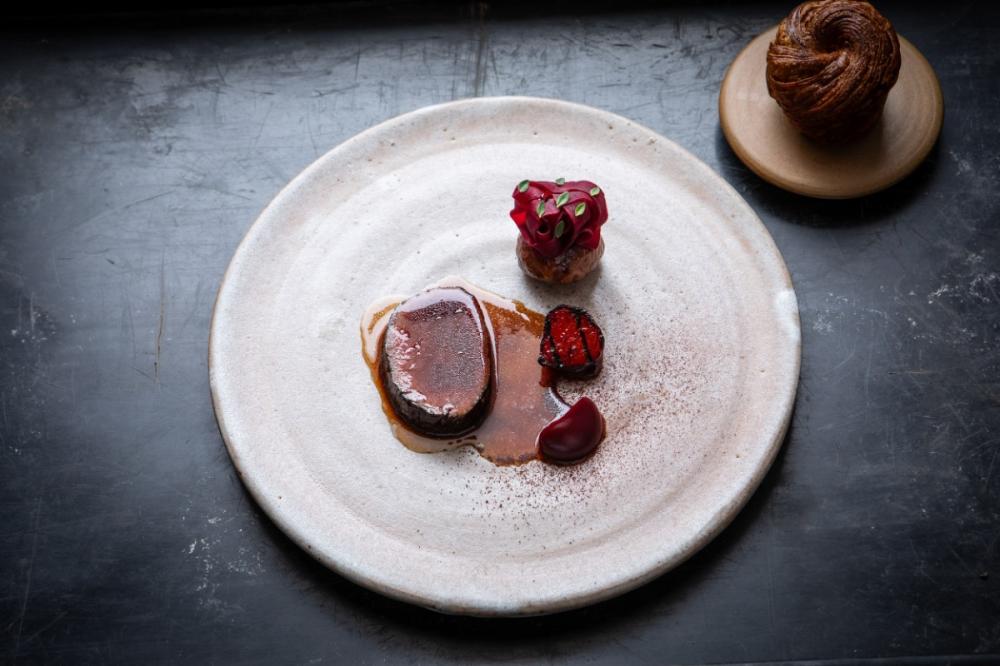
Roots, venison, beetroot, cherry
Photo: Andrew Hayes-Watkins
It is tempting, after twenty-five years in a village that the rest of the country has only lately discovered, to ask whether there is something about Yorkshire that London chefs genuinely fail to understand. Banks is too even-handed to take the bait.
"Running a restaurant in a rural place like Oldstead is very, very different from running one in a city centre. But equally, there are huge challenges involved in running a restaurant in somewhere like London. The challenges are just different. In London, for example, there's an enormous number of potential customers, but there's also a huge amount of competition. I imagine the same applies when it comes to recruitment and staffing. You can either be one of a small handful of the best restaurants in a county or one of many great restaurants in a huge city. It probably balances out in the end."
It is a characteristically grounded answer from a chef who has spent his career resisting the temptation to mythologise either his postcode or his trade. Spinning Plates Live arrives in York with its three timelines and its single, unfashionable conviction intact: that hospitality is worth fighting for and that the fight begins by telling the truth about it.
York Theatre Royal, Main House
Fri 17 Jul, 7.30pm
Age guidance: 12+ Book tickets here
The Black Swan, Oldstead
Roots, York
The Abbey Inn, Byland
Also by Andrew Palmer...
Leeds Song Festival Looks Inward For 2027 – And Finds A World Of MusicClassical Music: Encores for Mr ScottsClassical Music: Marcel DupréClassical Music: Vaughan Williams A Sea SymphonyClassical Music: Schmitt: Orchestral WorksThe shortened address for this article is: newspub.uk/01zky